
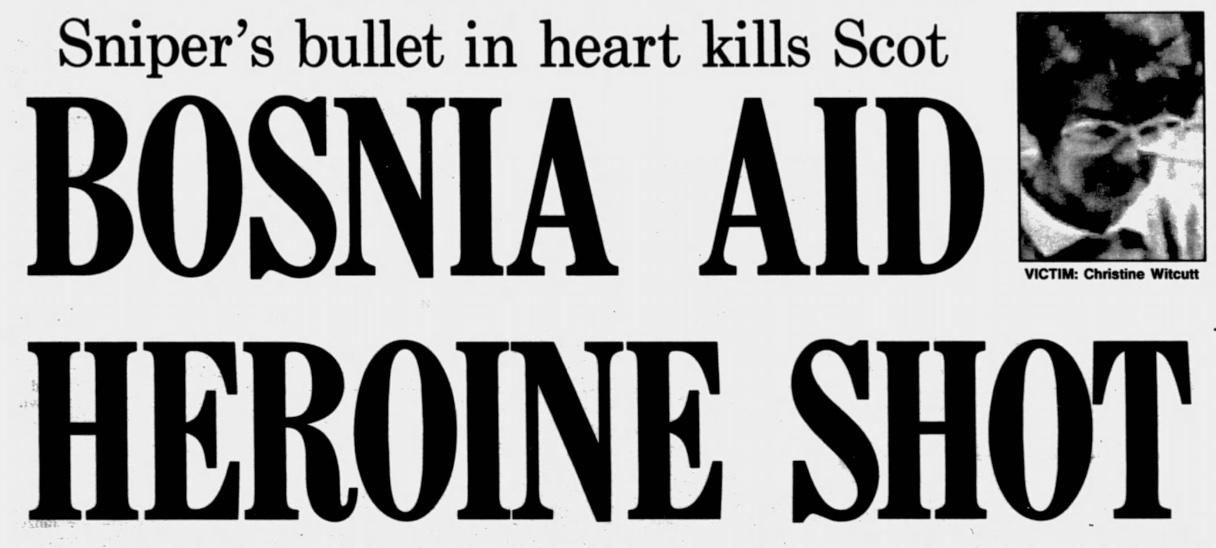
Christine Witcutt, a 52-year-old retired schoolteacher from the small Scottish town of Wishaw, was shot dead by a Bosnian Serb sniper on Monday, July 5, 1993, as the Edinburgh Direct Aid convoy she was travelling with pulled out of besieged Sarajevo along the road that had already earned its grim nickname: "Sniper's Alley." She was riding in the cab of a lorry near the back of the convoy, with fellow volunteer John Home Robertson driving the truck immediately ahead, when a heavy-calibre bullet tore through the cab and struck her. Although the lorries carried the words "Don't Shoot" painted in large letters on their sides a plea that had protected countless aid convoys before, the gunmen fired anyway. She was rushed in a CNN armoured jeep to a nearby military hospital, but her death, by every account, had been instantaneous.
Born in Clarkston, Renfrewshire, on March 28, 1941, during the Clydebank Blitz, Witcutt trained as a teacher at Jordanhill College and spent more than two decades in Scottish primary classrooms, latterly at Overtown Primary School in Lanarkshire, where she taught until her retirement in August 1992. Colleagues remembered her as a gifted, patient teacher with a particular talent for drawing out children with learning difficulties, and for sharing her love of music and the outdoors, she regularly took her pupils to the Highlands for hill-walking and camp-fires, and played piano and organ at her local Christadelphian church.
"She was a lovely person and a very good teacher who had the ability to bring out the best in many pupils. Christine taught with me for seven years and, although she had retired early, came back to the school quite often to play the piano at assemblies and tell the children stories about her first trip to Bosnia." Isabel George, headteacher, Overtown Primary School, the Herald, July 1993
It was Witcutt's lifelong friendship with a Clarkston woman married to an Albanian man in Kosovo arrested and ill-treated by Serb forces — that first drew her attention to the unfolding horror in the Balkans. When the letter describing her friend's ordeal arrived, Christine handed it to her husband Alan without a word, then said simply: "We must do something." The Foreign Office did not reply, and Amnesty International said it was already overwhelmed by requests from Bosnia. A friend at their church told them about a new Edinburgh charity, Edinburgh Direct Aid (EDA), founded the previous year by the mathematician and geneticist Dr Denis Rutovitz and his wife, Professor Jeanne Bell, to run relief convoys into the war-ravaged Balkans. Alan, a former coal miner and mobile-library driver, had a heavy-goods licence that made the couple especially useful, and in March 1993 they drove their first convoy to Travnik and Zenica.
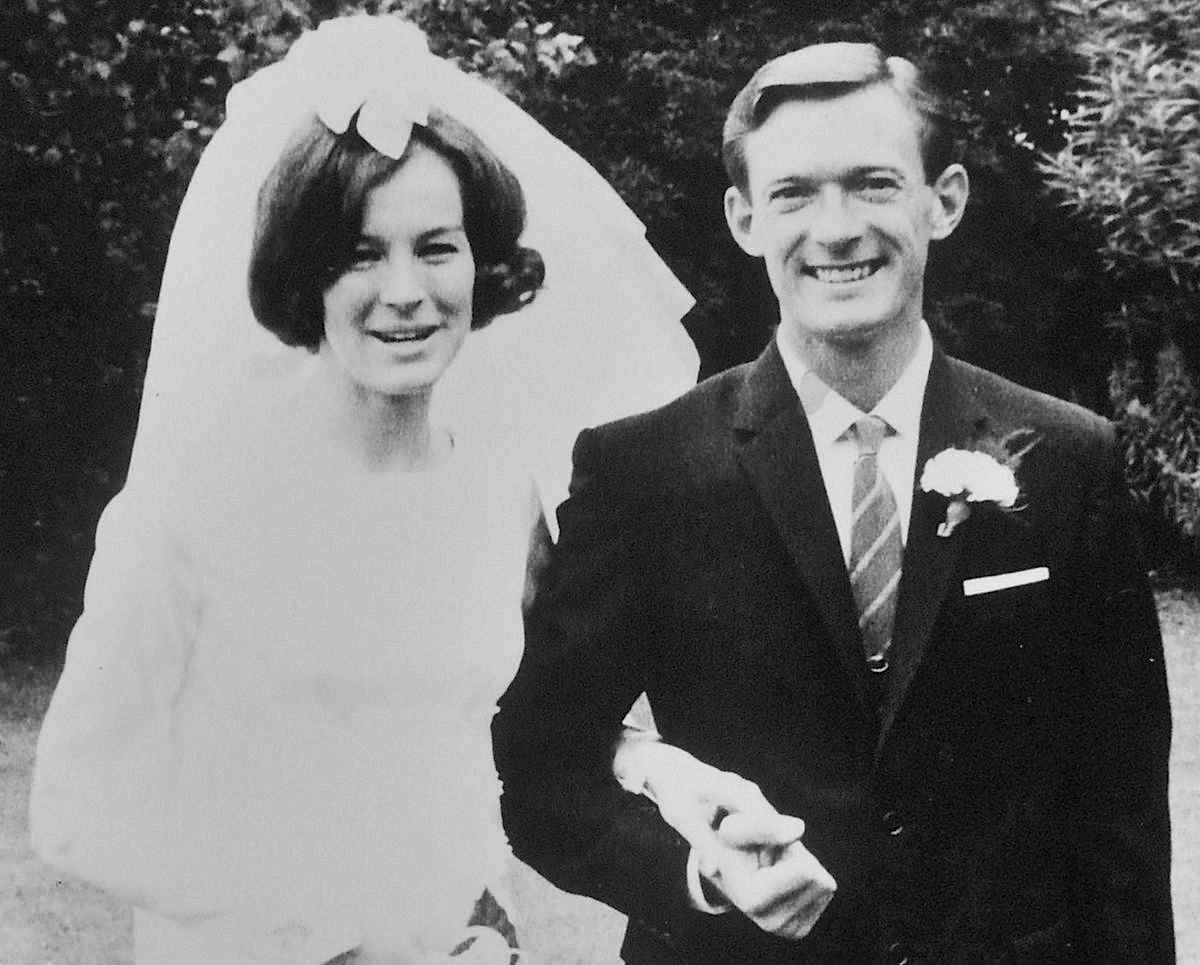 Christine and Alan Witcutt on their wedding day, 1966. The couple met through their shared membership of the Christadelphian Church and raised two children, Paul and Julie. Photo: Daily Record.
"The city was completely surrounded by the Serbs who were shelling it from the hills. We managed to get in but only by giving soldiers at each checkpoint some of our supplies. We effectively bought our way into Sarajevo. In the city, there were Serbs, Croats, Muslims, Protestants, Catholics but we didn't care who was getting our help, just that they were getting it." Alan Witcutt, Christine's husband, recalling their convoys into Sarajevo, Daily Record, 2013
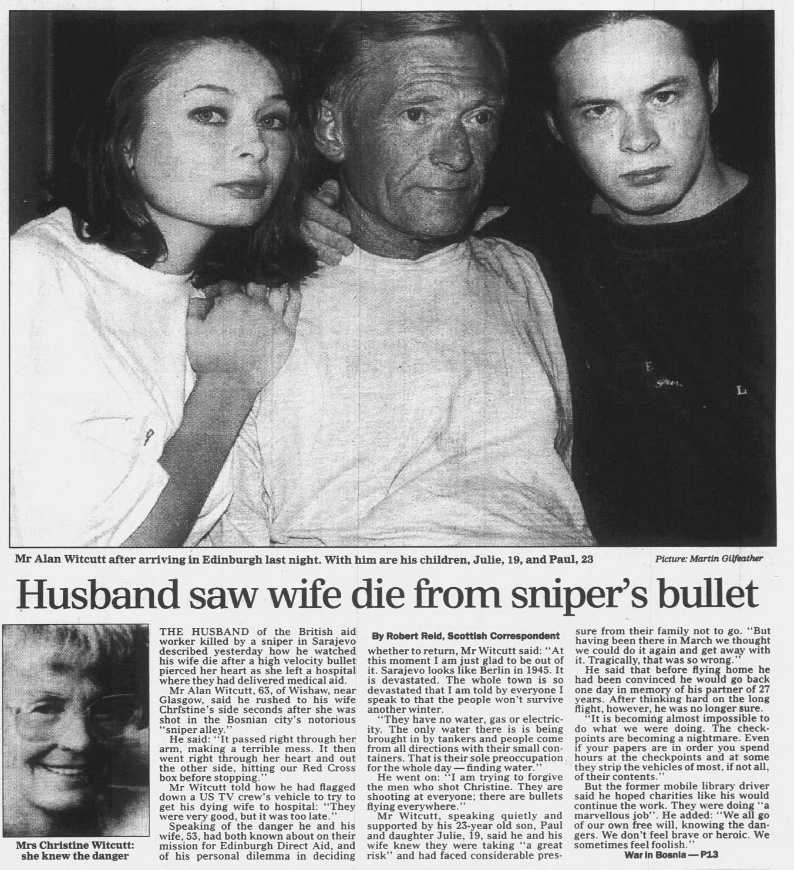
That June, the Witcutts joined another EDA convoy into Sarajevo, a journey that required leaving part of their cargo at checkpoints along the way and navigating repeated risks before finally reaching the city. The day they arrived, some 1,200 shells had landed on Sarajevo. The aid went to children's wards at Koševo Hospital and to families selected by UNHCR's social services. Christine's sister, a fellow retired teacher, had pleaded with the couple not to make the trip, fearing conditions had become too dangerous, but found Christine unmoved, the couple promised it would be their last, "for the sake of the family."
"Christine's need for adventure and a sense of freedom were a driving force in her life. She was a loving, caring and cheerful person, full of life and energy and with a strong sense of right and wrong... I felt that it was far too dangerous but Christine and Alan were adamant and promised that this would be the last time that they would go. We all realised that it was a very brave thing to do and prayed for their safe return. Christine was born in a blitz and has subsequently died in a blitz. She will be greatly missed by all who knew her." Elspeth Thorburn, Christine's sister, the Herald, July 1993
Christine's own last words to her sister before leaving for Sarajevo were characteristically unflinching: "All life is dangerous and no-one knows when time is up for them. I'm sure we'll be fine anyway." On the day they were due to leave the city, a security operation delayed the convoy's clearance, but by midday they were told it was safe to go. All warring factions had reportedly agreed to hold their fire to let the aid trucks pass safely out along Sniper's Alley. The agreement counted for nothing. Alan, driving ahead, heard the radio crackle: "Pull over when you can. We've had an incident." He reached his wife's truck to find her already gone.
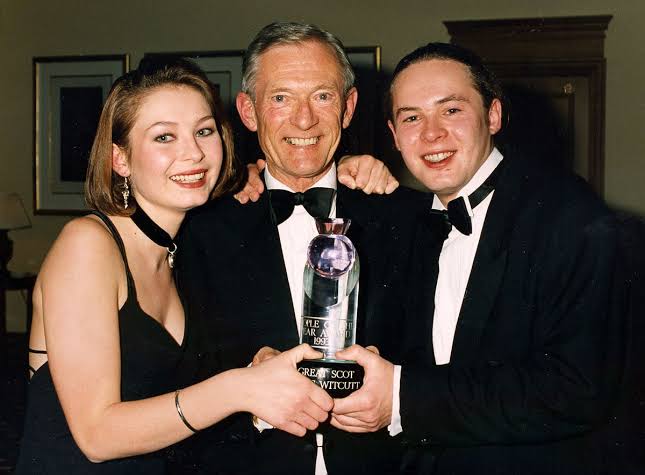 Alan Witcutt with his children Julie and Paul, accepting the Sunday Mail's "Great Scot" award on Christine's behalf, December 1993.
Photo: Daily Record.
Witcutt's death very nearly ended Edinburgh Direct Aid altogether, volunteers were left asking whether they had any right to keep sending ordinary people into such danger. It was Alan who answered that question. After a period to grieve, he urged the charity to keep going, insisting this was what Christine would have wanted. Then, within days of returning home, at a London press conference attended by some thirty reporters, he did something that stunned the room: when a journalist asked what he thought of the people who shot his wife, Alan replied, "I'm trying to forgive them." He spent much of the rest of his life explaining that single sentence, in sermons and talks later recorded by the National Library of Scotland.
"I had travelled to London to meet Alan from the plane which brought him home from Sarajevo. There was a press conference at the airport: maybe thirty journalists in attendance. I could not guess what Alan would say in reply to the reporter who asked 'What do you think of the people who shot your wife?' And I cried when with great humanity and dignity and faith he replied 'I'm trying to forgive them.'... Alan had no education in theology; he had no training in public speaking; and he preached the most remarkable sermon I have ever heard. 'However hard it is,' said Alan, 'forgiveness is what Christianity is. I would be a hypocrite if I did not try every day to forgive those who killed Christine.' I thought then it was the most remarkable sermon I had ever heard. I think so still."
Rev. Andrew McLellan, former Moderator of the General Assembly of the Church of Scotland_
Witcutt was posthumously named the Sunday Mail's "Great Scot" of 1993, an honour Alan and their children, Paul and Julie, accepted on her behalf at an emotional ceremony that December.
"We had no idea Christine would be named Great Scot but, when the announcement was made, we were overjoyed... It was hard to watch the video about Christine's work on the night but it was an incredible feeling, sorrow and pride at the same time. It gave us such happiness that the Sunday Mail chose to honour her. It was one of the events of my life." Alan Witcutt, Daily Record, June 2013
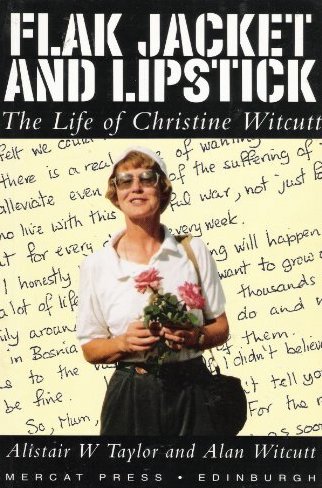
Alan went on to co-author a book, Flak Jacket and Lipstick, with Christine's brother, Alistair Taylor, recounting the couple's convoys and Christine's death. He stepped out from behind the slide projector where he had once stood while Christine gave the talks, and began delivering lectures and sermons himself on forgiveness and the plight of Bosnia, work that continued for the rest of his life. In January 2001, Alan and daughter Julie returned to Sarajevo for the opening of the Christine Witcutt Day Care Centre, built within the grounds of the Vladimir Nazor special needs school in New Sarajevo, a living memorial providing care, physiotherapy and speech therapy for children with severe disabilities. Edinburgh Direct Aid funded the centre for its first years before the Sarajevo Canton government assumed responsibility. It was at that 2001 opening that Alan met a young aid volunteer named David Hamilton, who would go on to marry Christine's daughter, Julie, extending the Witcutt family's humanitarian legacy in Bosnia across two generations; Hamilton later became Chief of the Scottish Police Federation and a leading voice behind Remembering Srebrenica Scotland.
"It is a privilege to visit Srebrenica and learn first-hand how survivors and bereaved family members of the genocide have fought to preserve the memory of their loved ones... Brave people like Christine Witcutt, who put herself in the front line to help those so desperately in need during the conflict, represented a beacon of hope and compassion amid appalling suffering — and Christine's humanitarian work lives on in the centre created in her memory." Nicola Sturgeon, then First Minister of Scotland, visiting the Christine Witcutt Centre in Sarajevo, August 2016
The Bosnian government honoured the Witcutt family's sacrifice with a specially struck medal presented to Alan in 2005. He continued to raise money for the day care centre and to speak publicly about forgiveness for the rest of his life. In 2019, Alan published his own memoir, Nine Lives and More, with all proceeds going to the Christine Witcutt Fund "a fascinating insight," his obituary in the Scotsman noted, "into a complex, devout and principled man." Alan Witcutt died on May 19, 2020, two weeks short of his 90th birthday, survived by his son Paul, daughter Julie, and three grandchildren.
"It was assumed this would be the end of Edinburgh Direct Aid, but Alan could not let it stop there. He urged the charity to keep going and then, perhaps most remarkably of all, asked for forgiveness for the sniper who had killed his wife. His humanity and his Christianity became an inspiration to many." Obituary of Alan Witcutt, the Scotsman, June 2020
In October 2025, Christine's story was retold once more in journalist Fred Bridgland's book From Scotland, With Love, a history of Edinburgh Direct Aid dedicated to the volunteers who "chose compassion, humanity and bravery over conflict." The following week, MSP Clare Adamson lodged a motion in the Scottish Parliament asking colleagues to remember Christine Witcutt "from Wishaw, who sadly lost her life in Sarajevo while delivering humanitarian aid," and to commend the book for keeping her legacy, and that of the other EDA volunteers, alive.
"That the Parliament remembers Christine Witcutt, from Wishaw, who sadly lost her life in Sarajevo while delivering humanitarian aid in the 1990s... recognises that Christine's bravery, compassion and sacrifice are recognised in a new book, From Scotland with Love, by Fred Bridgland, notes that the book highlights how ordinary Scots risked their lives to help others." Motion S6M-19498, Scottish Parliament, lodged by Clare Adamson MSP, October 31, 2025
CHRISTINE WITCUTT The first Scottish aid worker killed in the Bosnian war. A retired primary school teacher from Wishaw, Lanarkshire, and volunteer driver for Edinburgh Direct Aid. Survived by her husband, Alan Witcutt, and children Paul and Julie. Posthumously named the Sunday Mail's "Great Scot" of 1993. Her memory lives on through the Christine Witcutt Day Care Centre, opened in Sarajevo in 2001 for children with special needs and the Christine Witcutt Fund, which continues to support a home-visiting service for disabled children in the city. Her husband, Alan, who famously said he was "trying to forgive" the sniper who killed her, died on May 19, 2020, aged 89.
CHRISTINE WITCUTT was born on 28 March 1941 in Clarkston, Renfrewshire, Scotland.
She was killed on 5 July 1993 on Snipers Alley in Sarajevo, Bosnia and Herzegovina,
shot by a Serb sniper while leaving the city with an Edinburgh Direct Aid convoy, at age 52.
__
Special thanks to David Hamilton