
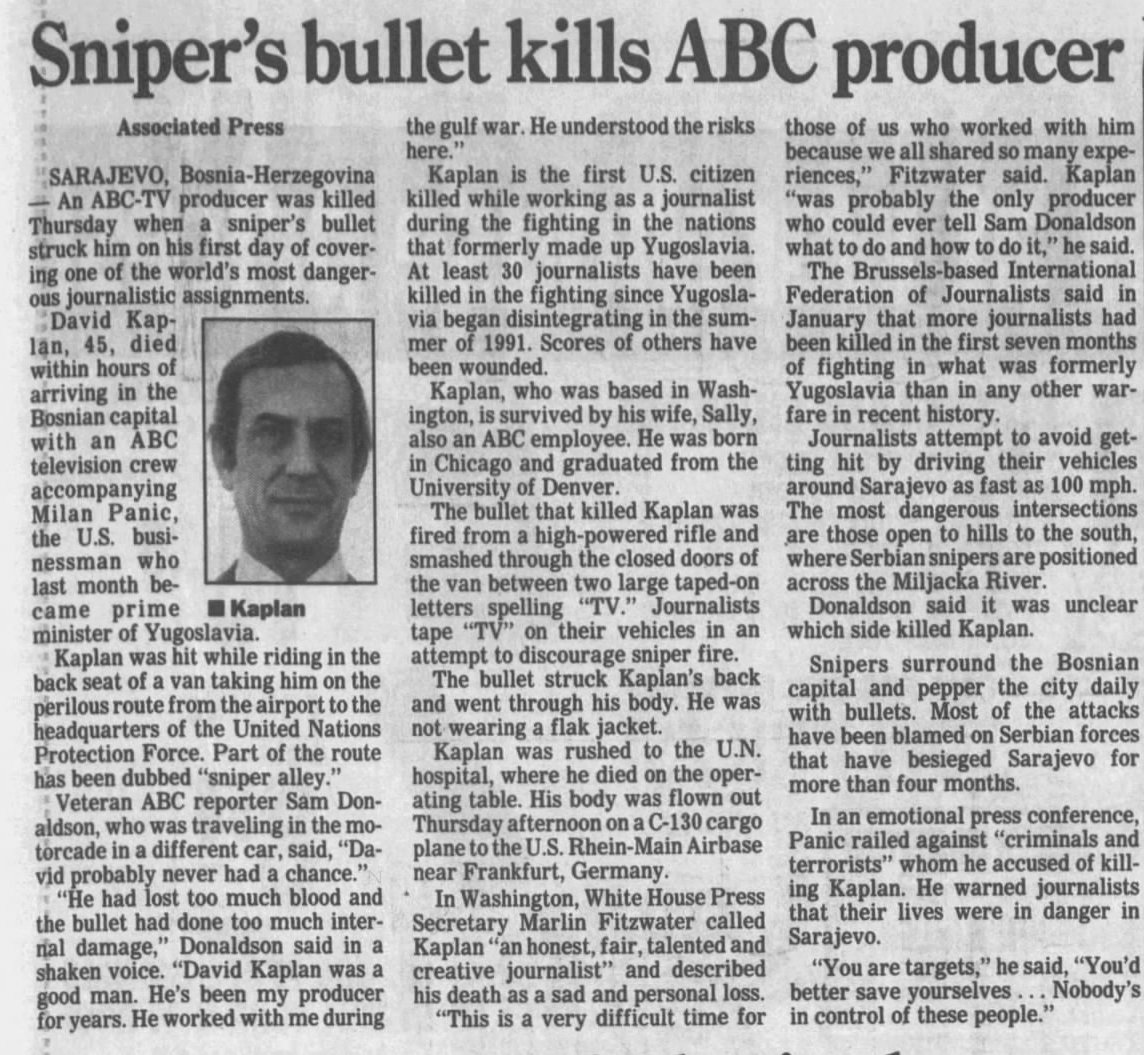
David Kaplan, a veteran American television news producer for ABC News, was killed by a sniper's bullet in Sarajevo on 13 August 1992 — his first day in the Bosnian capital, and his last. He was 45 years old.
Born in Chicago in 1947 and a graduate of the University of Denver, Kaplan spent more than two decades at ABC News, building a reputation as one of the network's most trusted hands. He covered political campaigns, the White House, and world news, serving for years as producer for correspondent Sam Donaldson — work that had already taken him through the Gulf War. Colleagues remembered him for the qualities ABC News President Roone Arledge later invoked: "humor, imagination, and yes, courage." He worked out of Washington, D.C., where his wife, Sally, was also an ABC employee.
In August 1992, ABC News had largely judged Sarajevo too dangerous to staff directly, relying instead on a British freelancer on the ground. But when Yugoslav Prime Minister Milan Panić — an American businessman who had just assumed the post — arranged a visit to the besieged city for peace talks, ABC saw a rare, seemingly protected opportunity: Donaldson and Kaplan would travel in with the prime minister's own convoy. "The feeling was that they would be with the prime minister, that they would be in a protected situation," an ABC News vice president said afterward.
It did not work out that way. The armored United Nations personnel carrier carrying Panić and Donaldson had no room for the rest of the crew. Kaplan — who, by several accounts, had left his flak jacket behind on the plane after telling Panić, "If you're not wearing one, I'm not wearing one either" climbed instead into an unarmored Volkswagen van borrowed from another television crew, alongside producer Ben Sherwood. The van's driver reportedly offered Kaplan his own flak jacket; Kaplan refused it.
"The bullet entered rear of the van right between the letters 'TV' that were written prominently on the back of the vehicle and continued to travel through the van, entering Kaplan from his back and exiting from his chest. The wound was massive and he died within minutes."
David Rust, CNN cameraman who witnessed the convoy depart Sarajevo Airport, recalling the shooting (quoted in Kenneth Morrison and Paul Lowe, Reporting the Siege of Sarajevo)
The convoy had just left Sarajevo Airport onto the road journalists called Sniper Alley when a single shot rang out. It tore through the rear doors of the van, passing directly between the two large taped letters spelling "TV" the marking journalists used, with increasingly uncertain effect, to warn gunmen off their vehicles. The bullet struck Kaplan in the back, severing an artery, and exited through his chest. He slumped onto Sherwood, the young producer riding beside him.
"David probably never had a chance. He had lost too much blood, and the bullet had done too much internal damage. David Kaplan was a good man. ... He's been my producer for years. He worked with me during the Gulf War. He understood the risks here."
Sam Donaldson, ABC News correspondent and Kaplan's longtime colleague, speaking to reporters hours after the shooting
Kaplan was rushed to a United Nations triage hospital set up inside Sarajevo's old post office building, staffed by French military doctors, but died there on the operating table. He was the first American journalist killed in the wars that followed Yugoslavia's breakup, and at least the 25th journalist of any nationality to die covering the conflict since fighting began the previous year.
News of his death reached the ABC News bureau in Washington, where his wife worked, within hours, leaving staff in shock. "He devoted his life to news and to this organization," said Roone Arledge, who called Kaplan "a wonderful friend and colleague." At the White House, Press Secretary Marlin Fitzwater described him as "an honest, fair, talented and creative journalist," adding that Kaplan "was probably the only producer who could ever tell Sam Donaldson what to do and how to do it." Prime Minister Panić, in whose convoy Kaplan had been riding, told reporters he was "deeply shocked" by the death of a man he called "my American friend," and later wrote that he "could not help but feel personally responsible."
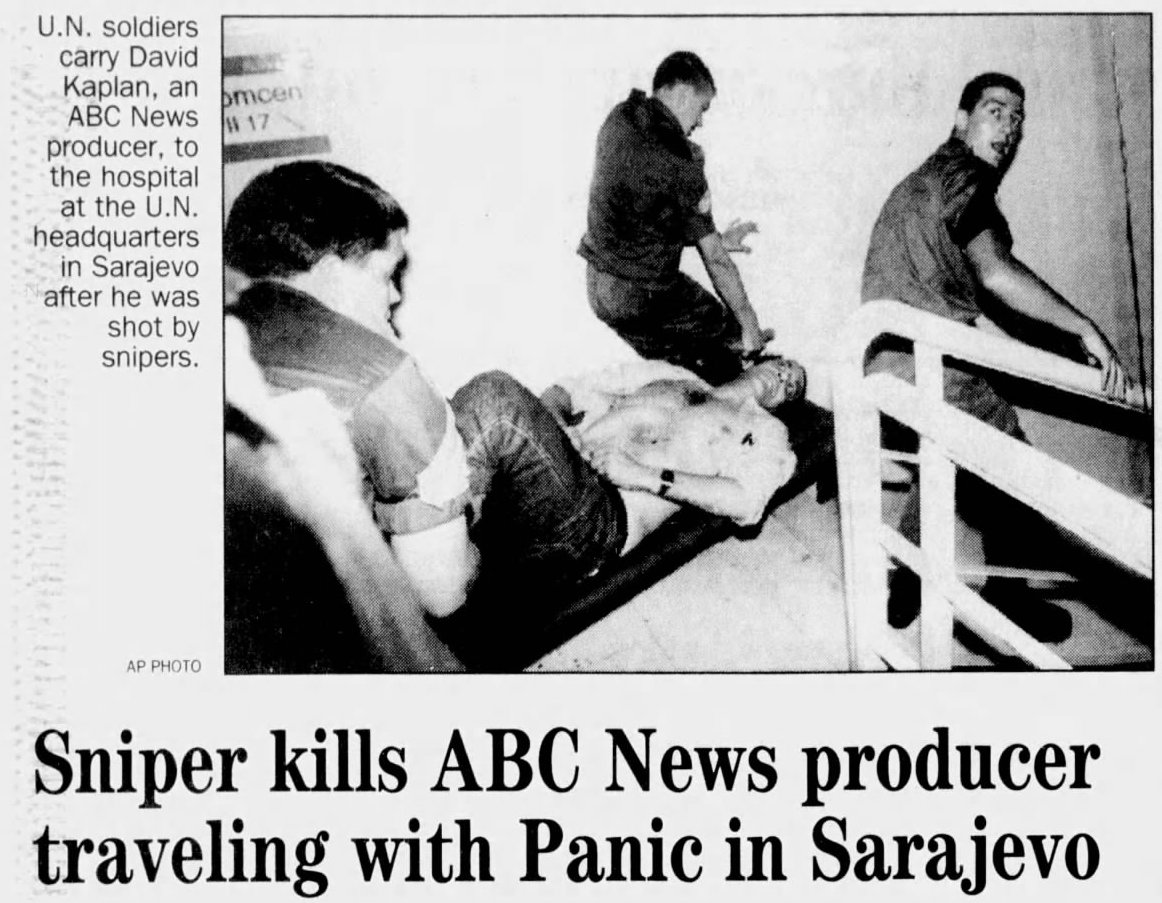
"That photograph is a reminder of that terrible day and the consequences and also the importance — of being out there doing those stories."
Ben Sherwood, recalling the two photographs from that day he still kept in his office decades later, one of the bullet hole in the press van, the other of Kaplan being carried into the Sarajevo hospital
Kaplan's death reverberated across the press corps covering Sarajevo. ABC immediately pulled its remaining crew — Donaldson, producer Ben Sherwood, soundman Dave Calvert and cameraman Doug Vogt, out of the city, and both ABC and CBS scaled back to relying on freelancers and pool coverage from Sarajevo for months afterward, a retreat that historians have argued allowed the war to slip from the center of American political attention during that fall's presidential campaign. CNN, by contrast, chose to keep correspondent Christiane Amanpour in the city. "It's tough on this end," said a CNN spokesman at the time. "People feel the same now with Kaplan" as they had weeks earlier, when CNN camerawoman Margaret Moth was shot in the face on the same stretch of road.
In October 1992, the Committee to Protect Journalists posthumously honored Kaplan with its International Press Freedom Award; his widow, Sally, accepted it on his behalf. The following year, Sam Donaldson established the David Kaplan Memorial Fellowship at the University of Missouri's School of Journalism, which each year still sends a student journalist into the ABC News Washington bureau for a semester. More than thirty fellows have carried his name since.
"David Kaplan was a seasoned news producer, someone ABC News's then-president remembered as a man of 'humor, imagination, and yes, courage.'
He had traveled to Sarajevo to cover a conflict, to help the world make sense of chaos."
Cherisse Halsall, 33rd David Kaplan Memorial Fellow, writing in 2025 about the legacy she inherited at the ABC News Washington bureau
The Overseas Press Club of America later named its own annual award for best televised spot-news reporting from abroad after him — the David Kaplan Award — a recognition, as the club put it, of a broadcast producer who "worked for ABC News for over 20 years, covering political campaigns, world news, and the White House throughout his career," in an era that the club's own historians have called "one of the deadliest eras for journalists in history."
David Kaplan, The first American journalist lost to Bosnia's war. Television news producer, ABC News, for over 20 years. Posthumously awarded the Committee to Protect Journalists' International Press Freedom Award, 1992. Honored by the David Kaplan Memorial Fellowship, Missouri School of Journalism, est. 1993, and by the Overseas Press Club of America's David Kaplan Award for best televised spot-news reporting from abroad.
David Kaplan born in 1947 in Chicago, Illinois. Graduate of the University of Denver.
Killed on 13 August 1992 in Sarajevo, Bosnia and Herzegovina, by a sniper's bullet on the road from Sarajevo Airport known as Sniper Alley, at age 45.
Survived by his wife, Sally Kaplan, an ABC News employee.
__