
Tony Ashby, the Australian photojournalist whose camera carried him into the siege of Sarajevo nine times and whose image of a frozen, hand-dug cemetery on the city's outskirts won him a Walkley Award, died on 19 April 2026 in Perth, aged 83. Across a career that spanned five decades, thirty-two years at The West Australian and years more freelancing for Agence France-Presse, he reported from Beirut, Belfast, Kigali, Kabul, Phnom Penh and the ash of Chernobyl. But it was Bosnia, and Sarajevo above all, that colleagues and family alike point to as the place where his work found its truest subject: not war, but the people who had to go on living inside it.
Anthony Bertram Ashby was born on 2 March 1943 at Rose Cottage in Upper Halling, Kent, a village west of Chatham, the son of Ivy (née Herrington) and Thomas Ashby, and brother to Edward, David and Betty. In February 1955, when Tony was twelve, his parents emigrated with him and Betty to Australia aboard the SS Strathnaver; David followed later that year after finishing National Service, while Edward remained in England to continue his medical studies. Tony would not see his eldest brother again for twenty-two years, until Edward finally flew out with his own family in 1977 and the Ashbys were reunited in full.
The family was housed first at the migrant camp at Point Walter before settling into a house on Botrill Street, Hamilton Hill, where Tony's father went to work at Cockburn Cement. Tony attended Fremantle Boys School until he was fifteen, then took an apprenticeship as a spray-painter with the Spearwood firm Howard Porter before moving on to Ford Australia. He loved the Australian way of life, the beach, a hotted-up Holden he customised himself, Aussie Rules football for the Cockburn Cement team, and, later, five completed marathons.
Photography, though, was the real pull. In the 1960s he began covering weddings, balls and 21st birthday parties for Kevron Photographics on William Street in central Perth, studying at night school to sharpen his craft. In 1966 he married Lyn Bain; their daughter Nicole arrived in 1968, their son Dean in 1970, and their younger daughter Louise in 1974. The same year Dean was born, Tony joined The West Australian, aged twenty-seven, and was soon a fixture of its pictorial departmentm a posting that would hold him for the next thirty-two years.
Into the wars
Tony's first assignment as a war correspondent took him to Beirut in 1982, at the height of Lebanon's civil war, a conflict he would return to cover on roughly ten occasions over fifteen years, at a time when Western journalists were routinely being abducted and held hostage. He came close himself: in Beirut he was once nearly kidnapped by armed extremists. "I had to do a lot of talking," he said afterwards, "but they eventually let me go." It was the beginning of a pattern that would define the next two decades of his life — heading toward the places most people were trying to leave, often travelling and funding the trips himself, filing both the pictures and, when no one else was there to do it, the words as well.
"Tony carried three weapons to war: cameras to take world-class images; a short-wave radio to hear BBC reporting on troubled places, and his warm personality, the greatest Ashby asset."
— Norman Aisbett, West Australian journalist and frequent reporting partner
Sarajevo
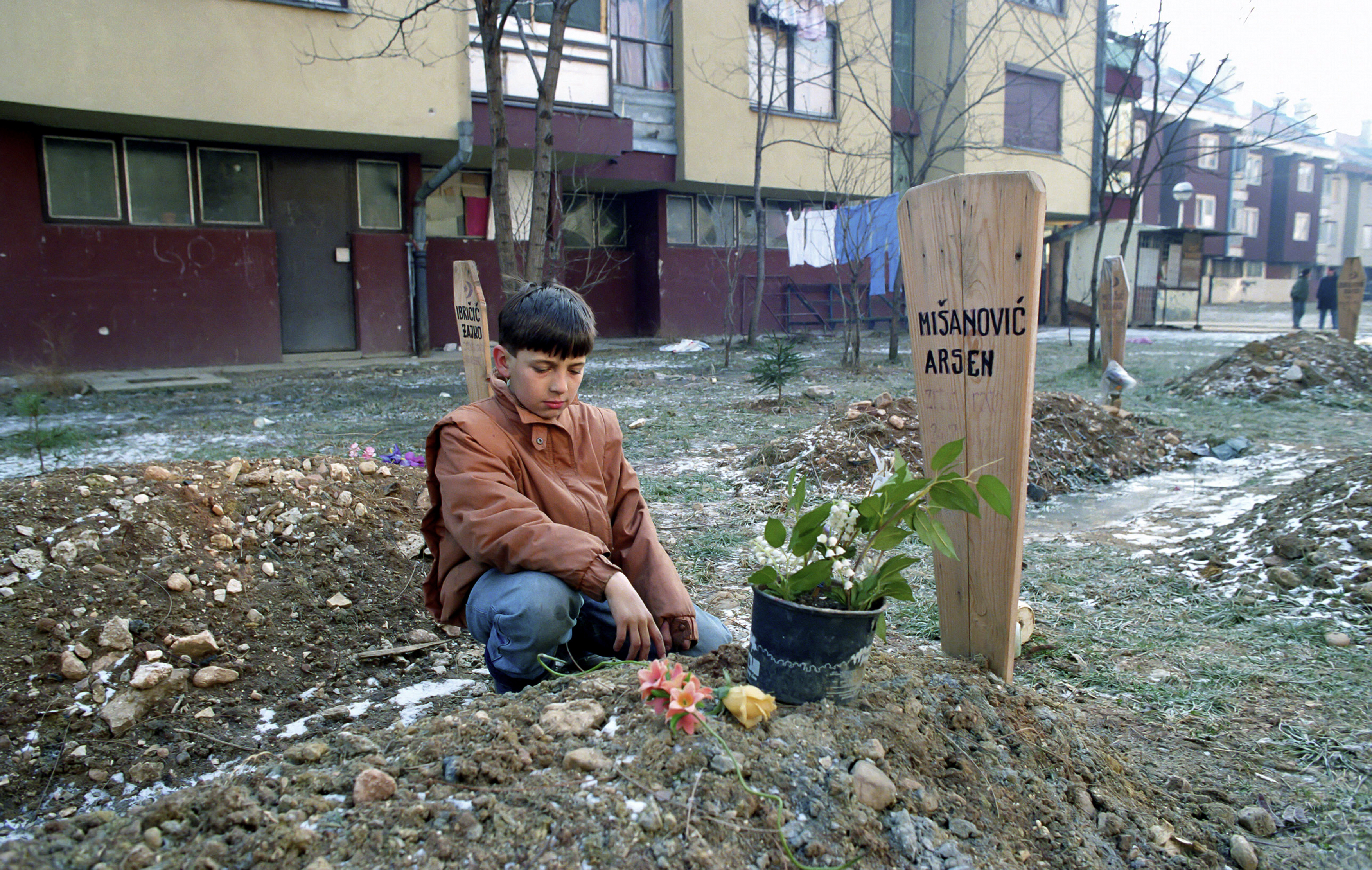 Temporary graveyard at Dobrinja neighbourhood in Sarajevo, photo by Tony Ashby'
It was in the former Yugoslavia, through the 1990s, that Tony's work found its deepest and most lasting register. He travelled to Croatia, where twenty-six journalists and photographers were killed in the first six months of the war alone, and he himself came under fire from helicopters on assignment there, his only cover a shallow ditch. But it was the siege of Sarajevo and the wider Bosnian countryside that pulled him back again and again, nine times in total, according to colleagues who tracked his movements through the Balkans, to document a city under constant shelling and sniper fire, cut off from food, power and water, where ordinary errands had become acts of courage.
In 1993, Tony won his first Walkley Award, Australia's most prestigious journalism prize, for the country's best news photograph: an image, taken in Sarajevo, of residents digging fresh graves by hand in frozen, snow-streaked ground, crude wooden markers already pushed into the earth around them, the ruined Oslobođenje newspaper building looming in the smoke-hazed background. Within his own family, this was remembered simply as his most acknowledged picture, a single frame that carried, more than any other, the weight of what he had witnessed.
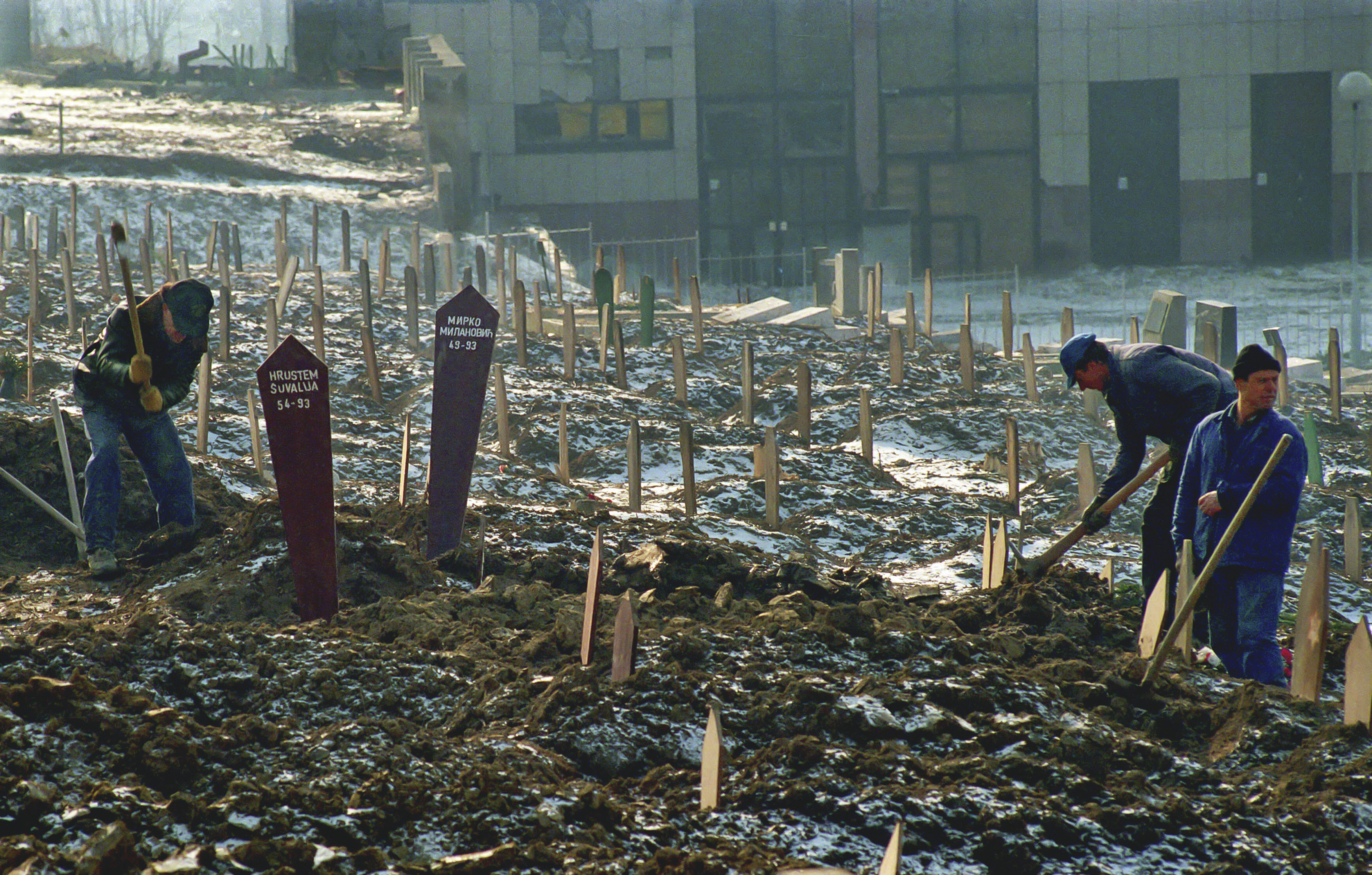 _Tony Ashby's 1993 Walkley Award-winning photograph of a makeshift gravesite
Former West Australian editor Paul Murray, who ran the paper from 1990 to 2000 and who sent Tony to the region, later singled out a different Sarajevo photograph as the one that stayed with him longest: an elderly woman, crouched low, hurrying across one of the city's exposed bridges directly into the line of sniper fire.
"She was just trying to get her groceries, risking her life every day. In his image you could see her making herself as small as possible, it was just someone trying to live a normal life in a war zone. It was one of those pictures that says a thousand words."
— Paul Murray, former editor, The West Australian
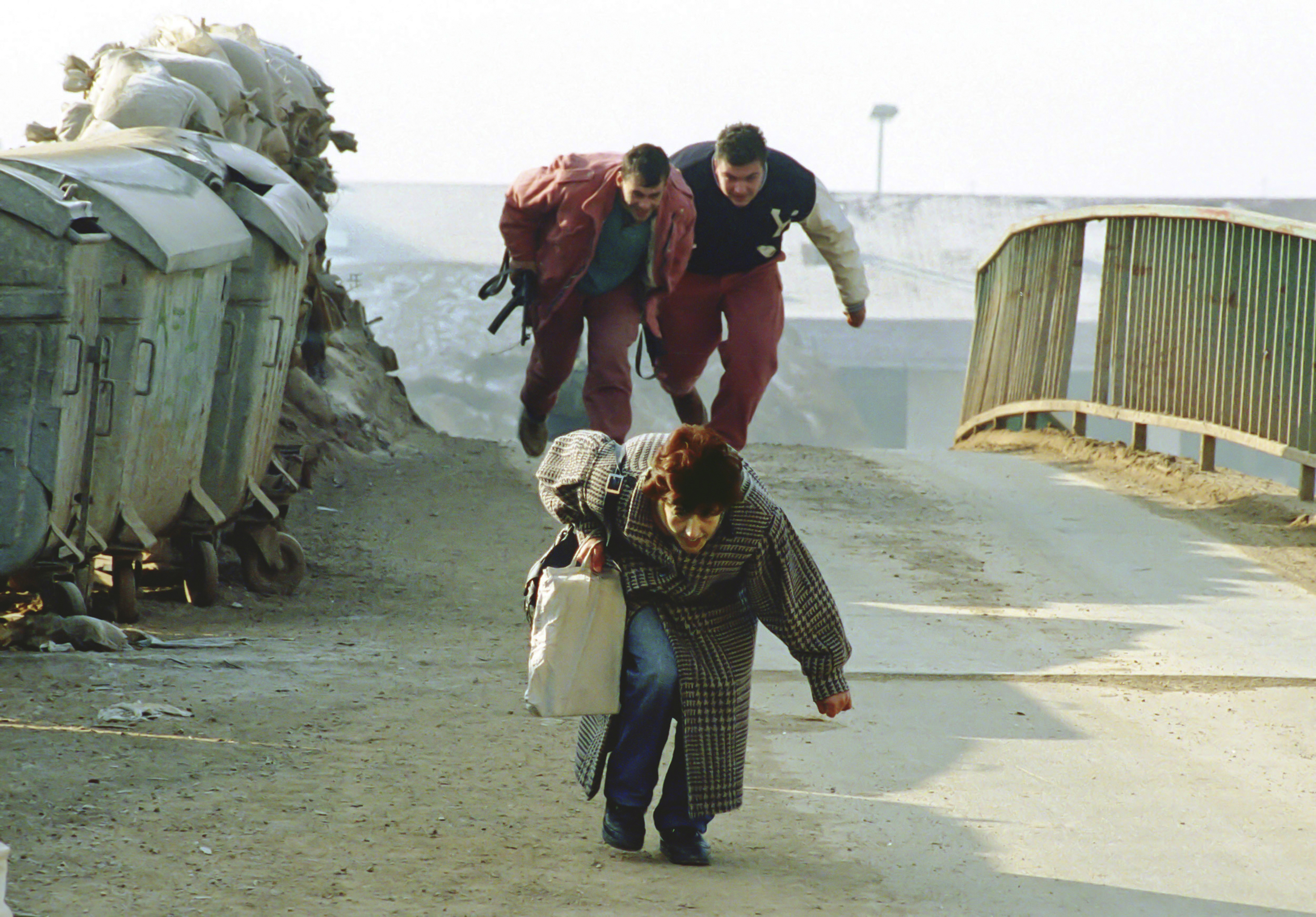 Dobrinja neighbourhood in Sarajevo, photo taken by Tony Ashby'
"What motivated him was the civilians caught up in war, that was the constant theme in his work. He wasn't attracted to the battle itself, he was drawn to how it affected people living through it. That's what made his work so special, it came from something innate in him."
— Paul Murray, former editor, The West Australian
Tony was once asked, directly, what kept drawing him back to danger. His answer was unadorned: "I made it my mission to document the horrors happening around me so that people everywhere will never forget them." He liked to invoke the American photojournalist Carl Mydans in the same breath: "I am making an historic record of our times." Those who worked alongside him in Sarajevo and the wider Balkans say he never treated that record as a trophy to be claimed. "I don't think he did it for the glory," Murray said. "Of course he appreciated the recognition, it acknowledged his talent and willingness to put himself on the edge but that's not what motivated him. He cared about the suffering of the people he photographed. He thought their stories deserved to be told." Those who knew him describe a man who was, in Murray's word, fearless, "even though he admitted he was sometimes afraid, he kept going back."
Beyond the frontline
Sarajevo was never the whole of it. Over the following years Tony's assignments carried him through Northern Ireland, Rwanda during the genocide, Zimbabwe, Mozambique, Bangladesh, the Occupied Territories during the Intifada, Sri Lanka's civil war, Cambodia under the shadow of the Khmer Rouge, Afghanistan under Taliban siege, Kosovo, Indonesia during the fall of President Suharto, and the fight for independence in East Timor. In 1991 he travelled to Chernobyl for the fifth anniversary of the nuclear disaster. In Rwanda, in 1994, his photograph of Australian Army Corporal Trevor Brown shaking the hand of a child at the Kibeho camp near Butare earned him a second Walkley Award. His lens turned just as readily to wildlife and ordinary life, the Virunga mountain gorillas, the Dalai Lama, Sir Paul McCartney, popes, presidents and champion athletes among them, proof, his colleagues say, of a curiosity that went well beyond conflict for its own sake.
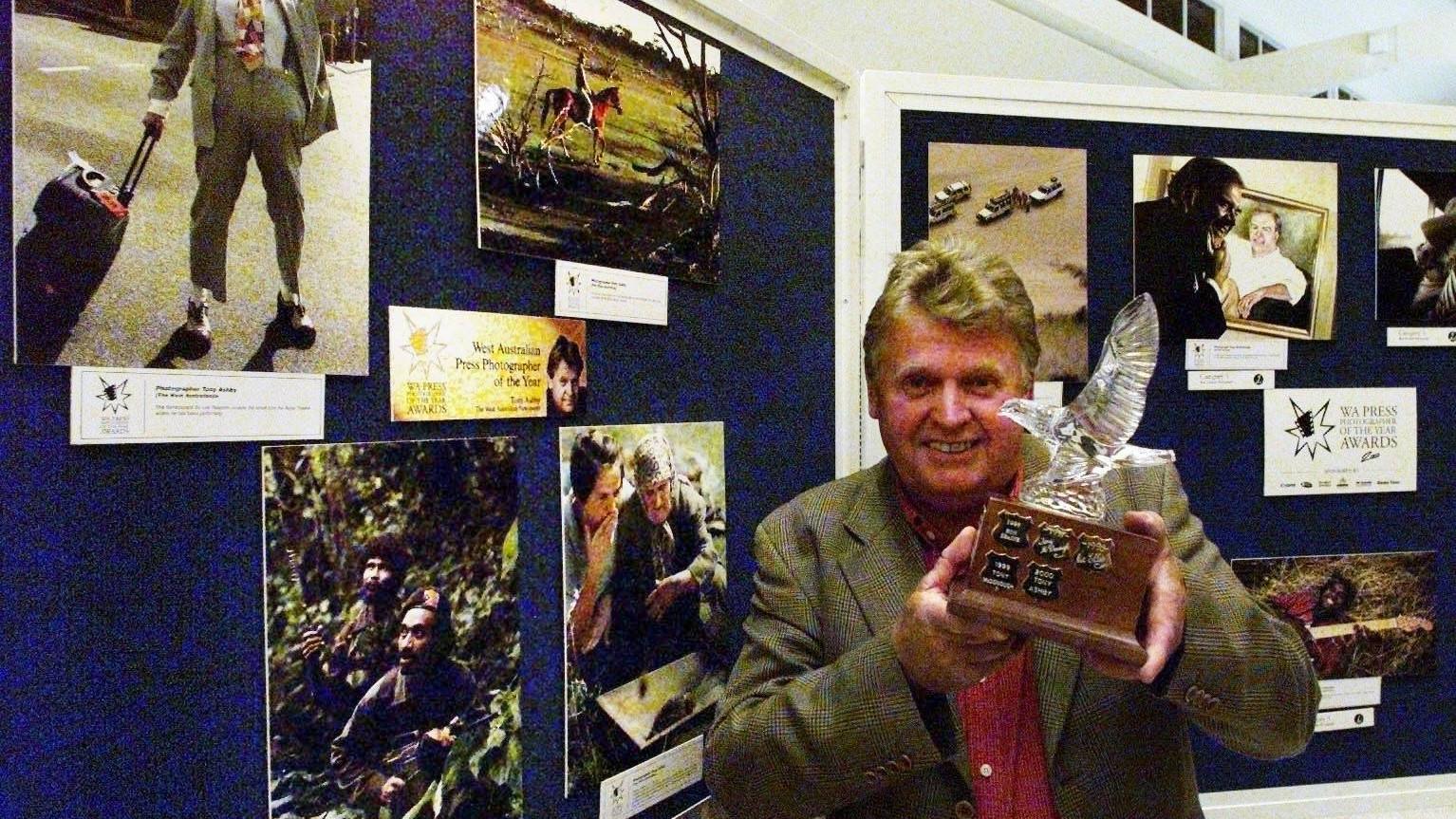 Tony Ashby with his trophy and winning photographs at the WA Press Photographer of the Year awards. Photo by Mogens Johansen
In the newsroom he was known by the nickname "Seagull," for a reputation as a good-humoured, slightly cheeky presence who was, by his colleagues' account, impossible not to like. "Tony was a kind guy, affable... always quick with a joke," Murray recalled, "he was great fun to be around — but there was always another side to him." That other side showed itself in the field: in his willingness to volunteer first to hang out of a helicopter door for a better angle, and in a compassion that, on at least one occasion, overrode the instincts of the job entirely. Visiting a hospital in Kabul, he learned that a young boy standing alone and distraught had just lost his sister in a rocket attack. Tony crossed the ward and held him. There was no photograph. It was, as one obituary later put it, a chance to substitute comfort for camera.
Family behind the lens
At home, the camera was never far from his hand either. His daughter Nicole remembers the smell of his pipe tobacco and his darkroom, and being allowed in to watch him develop prints as a child. Every milestone of her childhood, first days of school, broken arms, birthday parties, dancing concerts, sports carnivals — exists today because he photographed it.
"I remember the smell of your pipe and you letting me put the tobacco in. I remember the smell of your dark room and how you let me in to watch you develop the photos. Every aspect of my life in the early years... has been documented through your photos."
— Nicole Ashby, daughter
Even from the world's worst places, he found a way to stay close to his family. On Nicole's twenty-first birthday, he phoned from Beirut on an army telephone to wish her a happy birthday while sheltering in a hotel under bombardment. When his first grandson, Jake, was born, the call came from Afghanistan, on yet another dangerous assignment. "But somehow," Nicole said, "he always managed to call." In his later years as a grandfather, that same eye for the perfect frame followed his five grandchildren everywhere, he once asked a nurse to re-run his granddaughter's first bath because the lighting hadn't been right and she gave it to him again despite a glaring look.
"Dad I am so thankful that you were there for myself and my children at the worst of times and also the best. Your legacy lives on as every photo in my house has been taken by you... I am forever grateful that you were there for my first breath and I was there for your last."
— Nicole Ashby, daughter
Tony's marriage to Lyn Bain ended in divorce in 1984, the same year he bought a house on the hill in Sorrento. A year after retiring from The West Australian in 2002, he met Judi Griffin at a party; the relationship blossomed over shared interests, including travel, on the condition, his own, that war zones were now off-limits. They eloped and married in 2018, celebrating afterwards with a blessing at a local church alongside his brother Edward's family, visiting from England. Tony continued freelancing for Agence France-Presse and other outlets, increasingly turning his camera toward gentler subjects: cricket, the Hopman Cup, and above all his five grandchildren, Jake, Zac, Isabella, Nick and Vanessa and in time two great-grandchildren, Eden and Remi, along with stepdaughters Claire and Corrin.
A quiet reckoning
In 1994, the Library of Western Australia invited Tony to mount an exhibition of his photographs, which went on to tour the state. "Your still images captured from around the world," the library told him, "have more impact on us than the moving electronic images on the evening news." It was as close as he came to blowing his own trumpet. Those who worked with him say he remained humble about his two Walkley Awards and the other finalist nods that followed, more inclined to talk about the people in his pictures than about himself.
Dementia overtook Tony in his final year. He spent his last three months in hospital respite and the final six weeks at Crystal Halliday aged care home in Karrinyup before he died on 19 April 2026, survived by his wife Judi, daughters Nicole and Louise, son Dean, five grandchildren, two great-grandchildren and two stepdaughters. At a memorial held in Perth the following month, the image that colleagues kept returning to was not one of violence, but of restraint, an old woman trying to cross a Sarajevo bridge without being seen, a boy in Kabul who needed holding more than he needed to be photographed, and a photographer who, for fifty years, kept choosing to look closely at the people the rest of the world preferred to look away from.
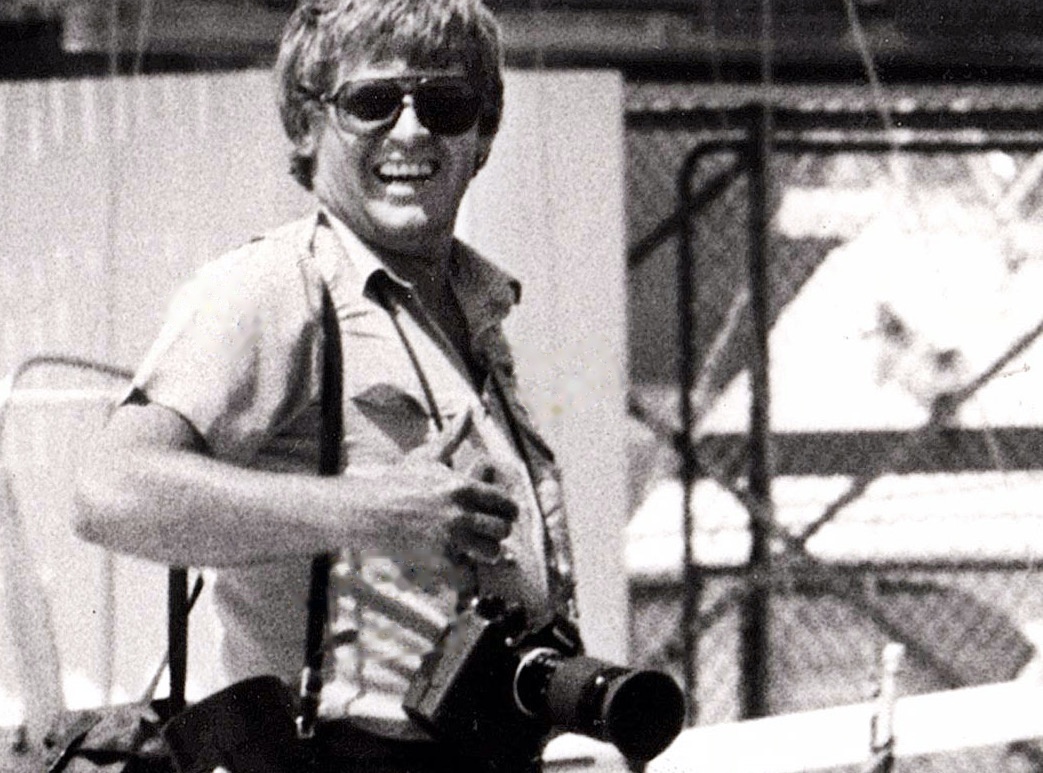 TONY ASHBY, Born Anthony Bertram Ashby,
on 2 March 1943, Upper Halling, Kent, England.
Died 19 April 2026, Perth, Western Australia, aged 83.
Survived by his wife Judi, daughters Nicole and Louise, son Dean, five grandchildren: Jake, Zac, Isabella, Nick and Vanessa, two great-grandchildren, Eden and Remi, and two stepdaughters, Claire and Corrin.
__
Cover photo The West Australian
Special Thanks to Nicole Ashby
Thanks to Paul Murray, Norman Aisbett and Patrick Cornish