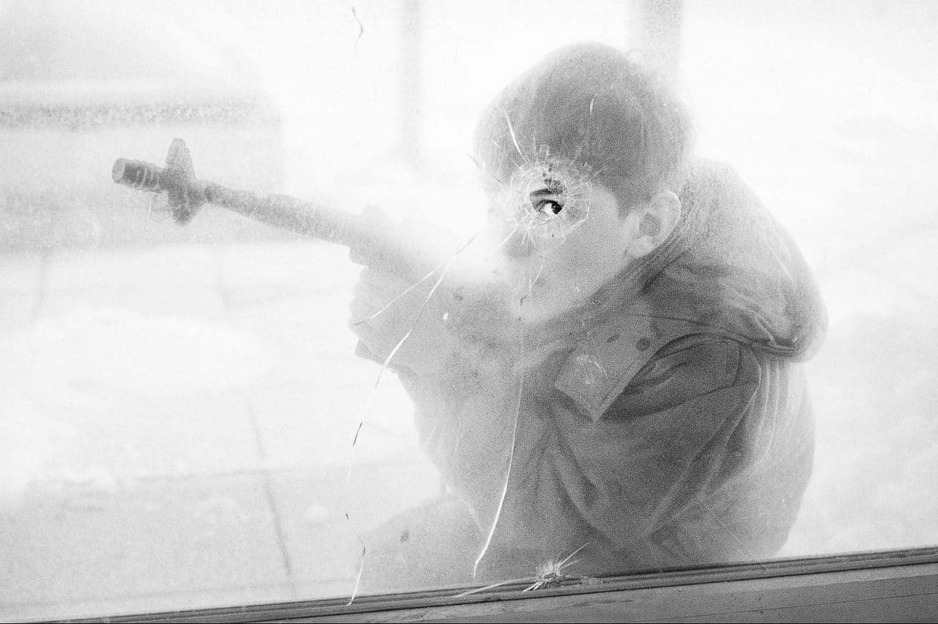
The Sniper Alley project aims to create a photographic archive from besieged wartime Sarajevo, to enable Bosnians to find images from the period of relatives and friends – and help its founder find pictures of his brother who was killed.
Dzemil Hodzic launched the Sniper Alley site in an attempt to collect and save all the wartime photographs he could find from Sarajevo in one place, establishing a database that will be easily accessible to anyone who wants to find images from the years when the Bosnian capital was under siege in the 1990s.
“As you might notice, there are lot of groups on social media, Facebook or Instagram that post that type of material that should be archived, because if someone decides to shut down that page, they will no longer exist,” Hodzic, who now lives in Qatar, told BIRN.
Many of these online groups are the only source for Bosnians to find photos of their family members or themselves from the siege period, which began in April 1992 and lasted for more than three years – the longest siege of a European city in contemporary history.
However, these online groups are hard to search, most of them do not have precise photo credits or failing to provide accurate information, which is why Hodzic decided, with some help from friends, to launch the Sniper Alley website in August this year.
“I do not have any photos of growing up in Sarajevo during the war, as we did not have the means [to take them], nor any of my family, and that is something that I think of all the time,” he said.
“It bothers me that I do not have any school, birthday or family photos from that period. A single photo from that time would make my day,” Hodzic wrote in his personal story on the Sniper Alley site.
He is in contact with many wartime photographers who were in Sarajevo or elsewhere in Bosnia at that time and said that many of them are willing to contribute.
For Hodzic, who was nine years old when the war started, the project is also a way to get more photographs of or anecdotes about his older brother Amel, who was killed in May in 1995, at the age of 16. He was one of a total of 1,601 boys and girls who lost their lives during the siege, according to data compiled by NGOs and war victims’ associations.
“Through this project and my story, I’ve initiated a search for any photos of my brother, Amel, so I am using this opportunity to call on all of those who might have a photo of him, any story, to share it with me,” Hodzic said, appealing to people to get in contact via the Sniper Alley site.
‘Everyone suffered’
In his personal story on the site, Hodzic writes about his disrupted childhood and the death of his brother. He admitted that this was not an easy task for him.
“I have kept it to myself for so many years… like I was feeling ashamed to talk about my personal tragedy, as there were so many others,” he explained.
“In the end, it is hard to find anyone who did not suffer [in the war],” he added.
Recalling such memories can be painful, but Hodzic insisted it is important to document them.
“Details are important – every anecdote, every photo, every chocolate wrapper, all these are fragments of the wider picture of us, who survived the war, the siege,” he said.
“I do not want to condemn anyone but I would like to invite people to write, even if it is anonymously. Anything, anytime. I chose to write and I must admit, it helps me,” he added.
A legacy of truth
Ethnically-divided interpretations of the country’s wartime history and denials of wartime crimes also make it important for those who survived the conflict to tell their stories truthfully, he said.
“We cannot allow someone to change history, to rewrite textbooks and to force us to accept this twisted narrative,” he declared.
Future generations must inherit a legacy of truth and clear facts about the Bosnian war, he continued.
“Repeating the story is the only way to fight back against fascists and wartime criminals,” he said.
Hodzic still visits Sarajevo, mostly during the summer season and says that main feeling about his hometown is pride.
“Sarajevo itself represents pride… As strange and incomprehensible as this may sound, I raise my head up at the memorial to the murdered children where my brother’s name is. I proudly show the inscription to my son, who bears the same name as my brother,” he explained.
“I am proud of all those who lost their lives for our city. Fighters. Nurses. Journalists. Children. Parents. Photographers. This city knows how to appreciate those who love it.”
Wrritten by Mladen Lakić
__
Published by BALKAN INSIGHT in English on October 1, 2019.